
How We Rank Financial Products
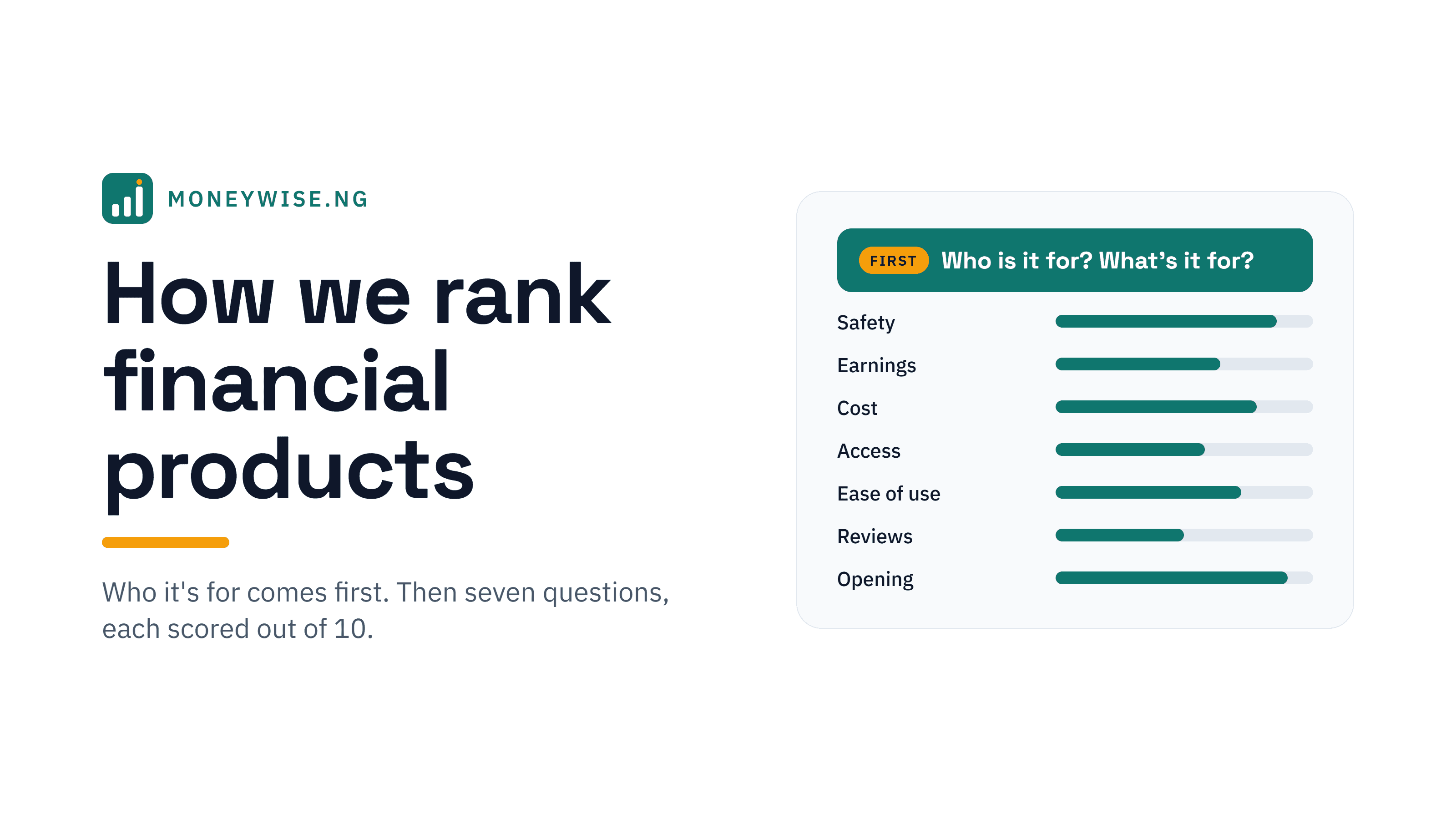
Every product on moneywise.ng is scored the same way, but no score beats the first question: who is it for, and what do you need it to do?
Introduction
Every product on moneywise.ng is scored the same way, out of 10, across seven questions. But no score beats the first question: who is this for, and what do you need it to do?
Start with you
The best product is the one that fits the person using it and the job they need it for. A 9/10 savings account is the wrong pick if you need a card it doesn't have, or if it is only open to people over 55.
So before any score, we ask two things:
- Who is it for? Students, young professionals, parents, retirees, people abroad, children and teens. Some products are built for one group and closed to others.
- What do you need it to do? Earn the most interest, spend easily, receive money from abroad, or keep savings out of reach.
This is why our lists are "best for" lists. Each pick names the person and the need it suits, and each product is compared only with others open to the same people. A kids' account is measured against kids' accounts, not against an account that needs a ₦500,000 opening balance.
The seven questions
Once we know who a product is for, we score it on seven questions. Each gets its own score out of 10.
| Question | What we check | How it is scored |
|---|---|---|
| Is my money safe? | Who regulates it, who holds your money, whether deposits are insured (by whom and up to how much), how fraud and failed transfers are handled, and the company's security history | Fixed standard |
| What will I earn? | Interest a year for savings and investments. For bank accounts, the interest you keep after fees | Against similar products |
| What will it cost me? | The monthly cost for a typical user, plus one-off charges such as card fees and penalties | Against similar products |
| How freely can I move my money? | Limits on what you can send, withdraw, receive and hold, the penalty for going past them, and how fast money moves | Mostly against similar products |
| How easy is it to use? | Ways to pay and receive, channels (app, USSD, branches, agents), cards, and how you get help | Mix of both |
| What do customers say? | App Store and Google Play ratings, Trustpilot, and the praise and complaints that keep coming up | Fixed standard |
| How easy is it to open? | Opening deposit, documents asked for, whether you can open it online, and how long it takes | Fixed standard: fewer requirements score higher |
How a score is worked out
Each question is made of a few checks, and its score is the weighted average of them. Checks that matter more count more: whether your deposits are insured weighs three times as much as whether there is a 24/7 fraud line.
- Compared with similar products. Interest, cost, limits and features are ranked against products of the same type for the same people. A product that beats 8 of 10 similar accounts scores about 8. If fewer than five similar products exist, we compare with the whole category.
- Small differences count as ties. Rates within 2% of each other score the same, so 8.175% and 8.25% are not treated as worlds apart.
- Fixed standards where there is a right answer. Insurance, regulation and documents asked for are scored against a set standard. If every product in a group is uninsured, none of them gets top marks for safety.
- Missing information is not a zero. We score only what we have confirmed. If we have less than 60% of a question covered, we say "Not enough data" rather than guess.
- Dealbreakers cap the score. A product with no licence cannot score above 3/10 for safety, and one with no deposit protection cannot score above 5/10.
Keeping it honest
- Checked at the source. Rates, fees and limits come from each provider's own website, price list or app listing, and every product shows the date it was last checked.
- Typical users, stated openly. Monthly cost and earnings figures assume a typical user, for example a ₦100,000 balance and 15 transfers a month. Every card shows the assumption beside the figure, and the full working sits under "How we work this out".
- Gaps are shown as gaps. Where a provider does not publish something, you see a dash, not a guess.
- A score is a starting point, not advice. It tells you how a product compares on paper. Whether it is right for you depends on who you are and what you need it for, which is where every one of our lists begins.
Not financial advice
moneywise.ng scores compare products on published information. They are not personal financial advice. Check the latest terms with the provider before you open anything.