Understanding Compound Interest: A Simple Walkthrough
A plain-language explanation of compound interest, with a worked example using real Nigerian savings rates.
Introduction
Compound interest is often called the most powerful force in personal finance, and for good reason. It is the difference between money that grows in a straight line and money that grows on a curve. Once you understand how it works, a lot of financial advice starts making more sense.
Key Takeaways
- Compound interest pays interest on both your original principal and any interest already earned
- The formula is: Future Value equals Principal times (1 plus rate divided by compounding frequency), raised to the power of frequency times years
- More frequent compounding and more time both accelerate growth, but time matters more
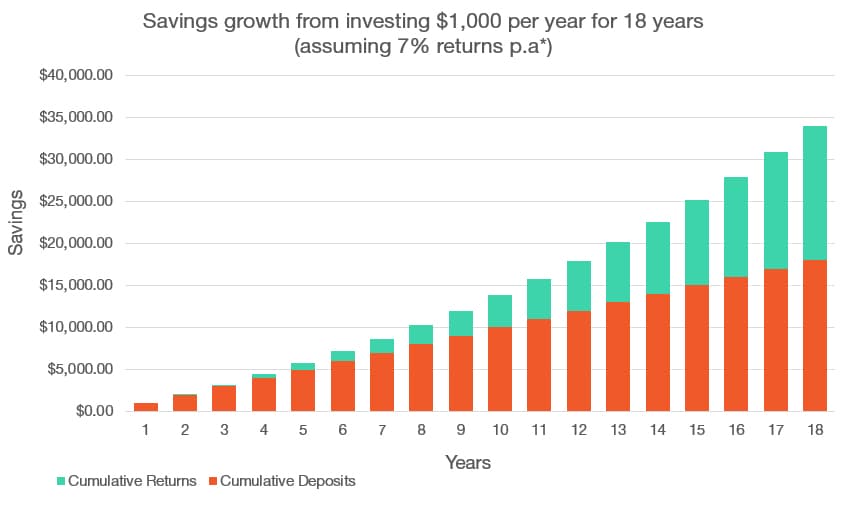
- Starting early has an outsized effect precisely because growth is exponential, not linear
In the Nigerian context, this matters concretely. A savings platform paying 14% a year and a money market fund paying 15% a year are not just earning you interest once, they are earning interest on top of interest every compounding period, which compounds the effect of even a small rate difference over time.
The concept, plainly
With simple interest, you earn a fixed amount every period, based only on your original deposit. With compound interest, each period interest gets added to your balance, and the next period earns interest on that new, larger balance. The gap between the two grows wider the longer money sits and the more often interest compounds.
The formula
Compound interest formula
FV = P x (1 + r/n)^(n x t), where FV is future value, P is your starting principal, r is the annual interest rate as a decimal, n is how many times per year interest compounds, and t is the number of years.
A worked example
Say you deposit 500,000 naira in a savings plan earning 14% a year, compounded monthly, and leave it untouched for 3 years. Using the formula: P = 500,000, r = 0.14, n = 12, t = 3. That works out to roughly 500,000 x (1 + 0.14/12)^(36), which lands close to 760,000 naira, meaning your money grew by about 260,000 naira without you adding a single extra deposit. Compare that to simple interest at the same rate, which would only have earned you 210,000 naira over the same 3 years, a gap of roughly 50,000 naira purely from compounding.
Common mistakes
- Comparing two rates without checking compounding frequency; a lower rate compounded more often can beat a higher rate compounded less often
- Withdrawing early and resetting the compounding clock, which loses far more growth than the withdrawn amount alone
- Underestimating how much starting a few years earlier changes the final number, because the effect compounds along with the money
- Ignoring fees or withholding tax that quietly reduce your effective compounding rate below the advertised one
Frequently Asked Questions
Does compounding frequency really make a big difference?
Is compound interest only relevant to savings?
What matters more, the interest rate or the time horizon?
Want to see how different savings platforms stack up on real interest rates? Compare Nigerian savings apps side by side.
Compare savings platforms