Can You Open a UK Bank Account as a Visitor from Nigeria? (2026 Guide)
Three forces work together to keep visitors out of UK current accounts: bank economics, international risk ratings, and the UK's address test. Understanding them saves you wasted applications and branch visits.
Introduction
Last updated: October 2026
Short answer: Almost certainly not. UK banks and apps like Monzo and Revolut require proof of a UK home address, and most treat short-term visitors as too costly and risky to onboard. The good news: a cross-border fintech card (such as Grey) on Apple Pay or Google Pay, backed by a domiciliary or prepaid FX card from your Nigerian bank, covers everything you need for a UK trip.
Introduction: the bank account that never happens
You have your visa, your flight is booked, and your plan is simple: land at Heathrow, walk into a Barclays or HSBC branch, open a UK bank account as a visitor, and spend like a local. After all, the UK is one of the world's great financial centres. How hard can it be?
For most Nigerian visitors, the honest answer is: very hard, and often impossible. Branch staff will ask for a UK address you can prove with official paperwork. App-based banks like Monzo and Revolut will ask for the same, then quietly decline your application or freeze it at the verification stage. Many travellers only discover this after arrival, when their Naira card has hit its foreign spending limit and every shop, Uber and Tube barrier wants a contactless card.
This is not about you personally, and it is not about your money. It is the result of how UK banks now price risk, how global anti-money-laundering standards have treated Nigeria, and a residency test that visitors cannot pass by design. The good news is that a well-planned set of alternatives works very well. This guide explains why the door is shut, and exactly how to build a financial setup that works before you board your flight.
Why visitors can't open a UK bank account
Three forces work together to keep visitors out of UK current accounts: bank economics, international risk ratings, and the UK's address test. Understanding them saves you wasted applications and branch visits.
1. De-risking: your account costs more than it earns
UK banks are supervised by the Financial Conduct Authority (FCA) and bound by the UK Money Laundering Regulations. Every new customer must be identified, verified, risk-scored and monitored for as long as the account is open. When a bank gets this wrong, the fines run into the tens or hundreds of millions of pounds.
Now look at a tourist account from the bank's side:
- High onboarding cost: foreign documents that are harder to verify, sometimes in formats their systems were not built to read.
- Ongoing monitoring cost: international inflows and card use from multiple countries trigger more alerts that a human must review.
- Low revenue: a visitor stays a few weeks, holds a modest balance, takes no mortgage or loan, then leaves the account dormant.
- Exit risk: dormant accounts held by non-residents are a known channel for money mules, which regulators watch closely.
The rational commercial response is "de-risking": declining whole customer segments rather than assessing each person individually. It is blunt and often unfair to genuine customers, but it is how most high street banks now operate.
2. The FATF factor: Nigeria is off the grey list, but the risk models lag behind
The Financial Action Task Force (FATF) is the global standard-setter for anti-money-laundering rules. Nigeria was placed on its grey list of jurisdictions under increased monitoring in February 2023. At its October 2025 plenary in Paris, the FATF removed Nigeria from that list after the country completed a 19-point action plan, alongside South Africa, Mozambique and Burkina Faso.
This is genuinely good news, and over time it should ease the extra scrutiny Nigerian customers face abroad. In practice, however, change is slow:
- Bank risk models are slow to update. Country risk scores draw on several inputs, including FATF history, corruption indices and the bank's own fraud data. Removing one input does not reset the score overnight.
- Enhanced Due Diligence (EDD) habits persist. Many institutions still route Nigerian applications into EDD: deeper source-of-funds questions, more documents and manual review. For a tourist account, that extra effort rarely makes commercial sense, so the answer is often "no".
- Fraud data matters as much as FATF status. Banks weigh their own historical losses by nationality and region, and that history does not disappear with a delisting.
The practical takeaway: delisting improves the long-term picture, but in late 2026 you should still plan as if a UK bank will treat your application with caution.
3. Proof of address: a test visitors cannot pass
Even if a bank were happy with your risk profile, almost every UK current account requires proof of a UK residential address. Typical accepted documents include:
- A council tax bill
- A signed tenancy agreement or mortgage statement
- A recent utility bill (gas, electricity, water or landline)
- A UK driving licence showing your address
A visitor staying in a hotel, an Airbnb or with relatives has none of these in their own name. Digital banks such as Monzo, Starling and Revolut UK apply the same rule: they are built for UK residents, and their automated checks will flag a non-resident applicant. Even the UK's legal right to a basic bank account applies to people who are lawfully resident, not short-term visitors.
The bottom line: this is not a door you can push open with persistence. The smarter move is to stop trying to become a UK bank customer and build your setup from Nigeria instead.
How to pay in the UK without a UK bank account
You do not need a UK bank account to live comfortably in the UK for a few weeks. You need three things: a way to hold pounds, a card that works contactlessly, and a backup. Here is how to build that stack.
Recommendation 1: Cross-border fintechs (your everyday spending tool)
Cross-border fintechs built for Africans are now the most practical option for most visitors. They onboard you with Nigerian documents, so the UK address problem never arises.
Grey (grey.co): the strongest fit for most visitors
Grey offers multi-currency accounts in USD, GBP and EUR, including UK account details (sort code and account number). In January 2026 it upgraded its virtual Visa card to support Apple Pay and Google Pay, so you can tap your phone at a till, on the Tube or in a black cab. The card spends directly from your GBP balance, which means no conversion at the point of sale.
How to set it up, step by step:
- Download the Grey app and sign up while you are still in Nigeria, ideally two to three weeks before your trip.
- Complete verification with your Nigerian ID (international passport, NIN or driver's licence) and any proof of address the app requests for your account tier.
- Open a GBP account inside the app to get your UK account details.
- Fund it by converting Naira, or by receiving pounds from family or clients into your GBP details.
- Create your virtual card from the Cards section. There is a small one-off creation fee.
- Add the card to Apple Pay or Google Pay. Wallet support applies in "supported regions", so do this and make a small test payment before you fly, not at the airport.
Wise: useful, but not as a Nigeria-resident spending account
Wise is excellent if you already live in the UK, Europe or North America. For people resident in Nigeria, however, its features are limited. Wise currently does not issue its debit card to Nigerian residents, and does not give them USD account details. Treat Wise as a tool for relatives abroad to send money to your Nigerian account, not as your travel wallet. If your circumstances change (for example, you relocate on a work or study visa), Wise becomes a strong option.
Other Nigerian-focused apps worth comparing: Geegpay and similar platforms also offer foreign-currency accounts and virtual cards. Compare card fees, FX spreads and whether wallet payments are supported before choosing.
Smart habits with any fintech card:
- Keep only what you need for the next few days on the card, and top up as you go.
- Turn on transaction notifications and 3D Secure approval.
- Note that some hotels and car hire firms prefer a physical card for deposits, which is where Recommendation 2 comes in.
Recommendation 2: Domiciliary accounts and prepaid FX cards (your physical backup)
A physical card from a Nigerian bank, funded in foreign currency, is your safety net for hotel deposits, car hire and ATM cash, and your backup if your phone is lost or a fintech card is declined.
Why not just use your Naira card? International limits on Naira cards have loosened in 2026 as FX liquidity improved, with some banks raising caps sharply. But limits still vary widely by bank and card tier, the exchange rate is set by your bank, and banks have tightened these limits suddenly before. Relying on a Naira card alone for a UK trip is a risk you do not need to take.
Option A: A domiciliary account debit card
Most tier-1 banks (GTBank, Zenith, Access, UBA, First Bank and others) offer USD, GBP or EUR domiciliary accounts with linked debit cards.
- Choose GBP if your bank offers it. Spending pounds in the UK avoids a second currency conversion. A USD card will work, but every purchase is converted from dollars to pounds, usually with a fee of around 2 to 3%.
- Ask about the card's international limits (per transaction, daily and monthly) before you travel, in writing if possible.
- Fund it early. Inflows into domiciliary accounts can take a few days to clear.
Option B: A prepaid FX card such as UBA Africard
Prepaid cards are not linked to your current account, so they sit outside the caps that apply to standard Naira debit cards. UBA's Dollar Prepaid Card is a good example: it works at international ATMs, POS terminals and online, with spending of up to $10,000 a month, and is funded from a UBA account.
How to use it well:
- Get the card two to four weeks before you travel, from a branch or via UBA's digital channels.
- Load only your planned trip budget, plus a buffer of around 20%.
- Notify the bank of your travel dates so UK transactions are not flagged as fraud.
- Check daily limits. A daily cap (often around $1,500) can bite on a big shopping day or hotel deposit.
- Keep the card separate from your phone, so one loss does not leave you stranded.
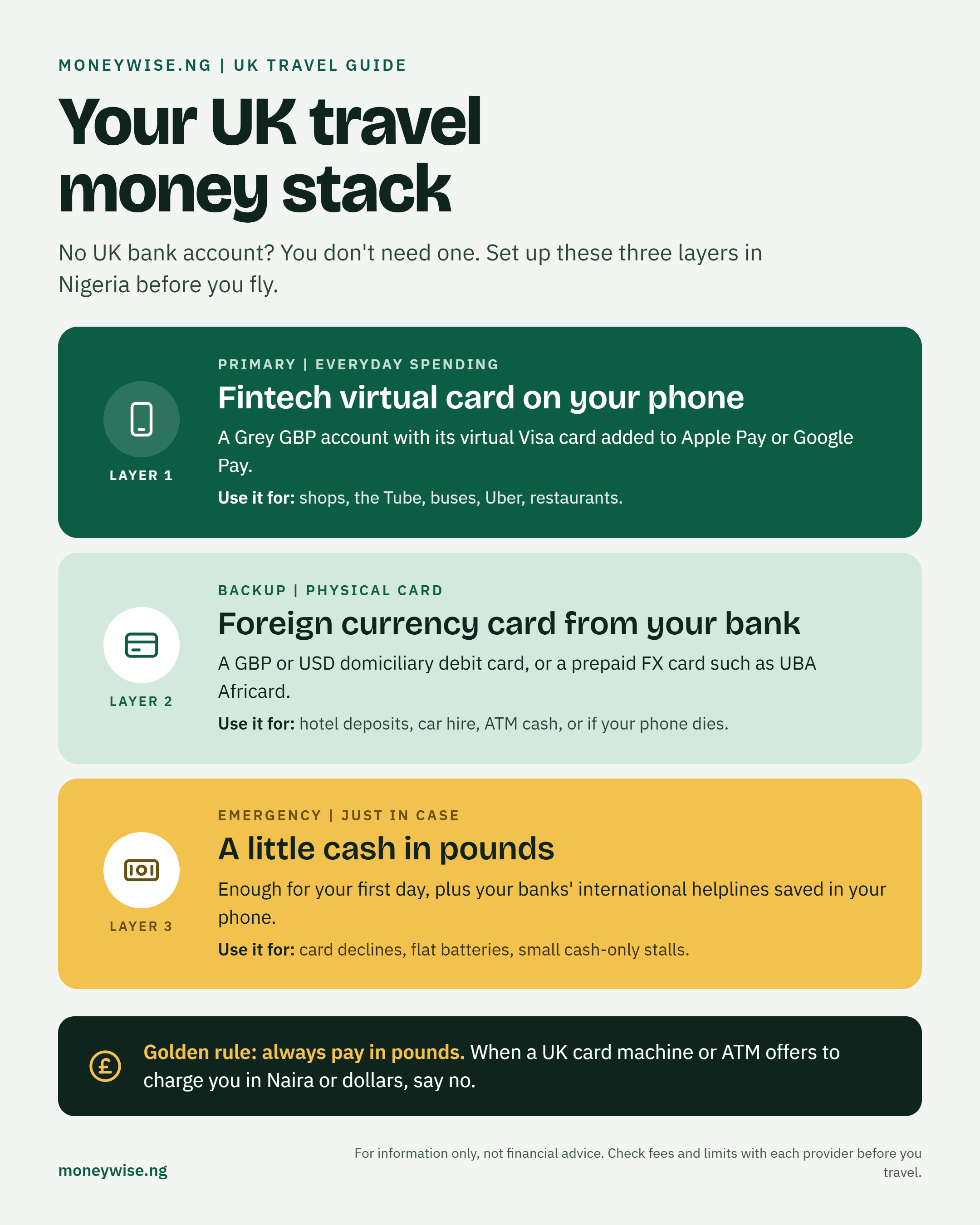
Always choose to pay in pounds. When a UK card terminal or ATM offers to charge you in dollars or Naira, decline. This "dynamic currency conversion" almost always uses a worse rate than your bank or card network.
Recommendation 3: Expat and international accounts (for high-net-worth visitors)
If you visit the UK often, pay UK school fees, own UK property or hold significant savings, an offshore "expat" account can give you real sterling banking without a UK address. The entry bar is high.
| Account | Where it is held | Typical entry requirement (2026) |
|---|---|---|
| HSBC Expat | Jersey, Channel Islands | Save or invest at least £50,000 within 3 months, or a salary of £100,000+, or existing HSBC Premier status in another country |
| Barclays International | Offshore (Isle of Man / Jersey) | Around £100,000 in deposits or investments; a monthly fee can apply if balances fall below the threshold |
Things to know before applying:
- These are not UK high street accounts. They are held offshore, so deposits are protected by the local scheme (for HSBC Expat, the Jersey scheme covers up to £50,000), not the UK's FSCS.
- Expect full Enhanced Due Diligence. Prepare evidence of source of funds and source of wealth: payslips, business accounts, property sale documents and tax records.
- Check eligibility for Nigerian residents specifically. Criteria and accepted countries of residence change, so confirm directly with the bank before transferring large sums.
For most visitors on a short trip, this route is overkill. It makes sense if you already need ongoing sterling banking, not just a holiday card.
Frequently asked questions
Can I open a Monzo or Revolut account as a tourist in the UK?
Generally, no. Monzo, Starling and Revolut UK are built for UK residents and ask for a UK home address during sign-up. Visitors on a Standard Visitor visa are usually declined or stuck at verification.
Does my Nigerian Naira card work in the UK?
Often, yes, if your bank has enabled international transactions. Limits loosened in 2026 but vary by bank and card tier, so confirm your limit and activate international use before you travel. Keep a foreign-currency card as backup.
Can I use Apple Pay or Google Pay in the UK with a Nigerian account?
Yes, with the right card. Grey's virtual Visa card supports Apple Pay and Google Pay in supported regions. Add it to your phone and test it with a small payment before you leave Nigeria.
Has Nigeria's removal from the FATF grey list made it easier to open a UK bank account?
Not yet in practice. Nigeria left the grey list in October 2025, but UK banks' risk models and due diligence habits change slowly, and the UK address requirement still applies regardless.
What is the cheapest way to spend money in the UK as a Nigerian visitor?
Spend in pounds wherever possible: use a GBP balance on a fintech card or a GBP domiciliary card, and always decline offers to be charged in dollars or Naira at UK terminals and ATMs.
Conclusion: build your financial stack before you board
The days of strolling into a London branch and leaving with a debit card are over for visitors. That is not a judgement on you; it is the product of bank economics, slow-moving risk models and an address test designed for residents. Nigeria's exit from the FATF grey list is a step in the right direction, but it will take time to show up in how UK banks treat applicants.
The winning strategy is simple: set everything up in Nigeria, test it, and arrive ready. A sensible stack for most visitors looks like this:
- Primary: a Grey GBP account with a virtual card on Apple Pay or Google Pay, for everyday tapping.
- Backup: a GBP or USD domiciliary debit card, or a UBA Dollar Prepaid Card, kept separate from your phone.
- Emergency: a small amount of cash in pounds for your first day, and your bank's international helpline saved in your phone.
Your pre-departure checklist:
- [ ] Sign up and verify on Grey at least two weeks before travel
- [ ] Open a GBP balance, create a virtual card and add it to your phone wallet
- [ ] Make a small test payment with the virtual card
- [ ] Request a domiciliary or prepaid FX card and confirm its international limits
- [ ] Notify your Nigerian bank of your travel dates
- [ ] Save customer service numbers for every card you carry
Do this, and you will spend your UK trip enjoying the city rather than queuing in banking halls. Safe travels, and spend wisely.
---
This article is for general information only and is not financial advice. Product features, fees and limits change often; confirm details with each provider before you travel.
Sources
- Nigeria exits FATF grey list (Gazette NGR, October 2025)
- Nigeria Removed from FATF Grey List (Aluko & Oyebode)
- Grey virtual card with Apple Pay and Google Pay (TechCabal, January 2026)
- Grey virtual card page
- Wise in Nigeria: card and account limitations (ClickStart NG)
- UBA Nigeria prepaid cards
- Nigerian banks raise international card limits (Legit.ng, 2026)
- HSBC Expat account opening FAQs
- UK bank accounts for non-residents (private.law, July 2026)