PiggyVest Piggybank Review in Nigeria: Fees, Withdrawal Rules and How Safe It Is
PiggyVest Piggybank is built for disciplined saving, not everyday access. Here’s how its 16% p.a. rate, quarterly free withdrawals, 3.5% early-withdrawal penalty and SEC-linked fund structure actually work in Nigeria.

Piggybank
Piggytech Global Limited (PiggyVest) · Flexible savings
Net earnings for a typical saver
₦14,400 on ₦100k for a year
Joint highest earner of 7- Interest rate
- 16% p.a.
- Interest paid
- Monthly
- Free withdrawals
- 4
- Breaking early
- A % of the amount
- Payout time
- Instant
- Minimum to start
- ₦50
- NDIC insured
- No(based on its licence)
Not confirmed yet: Money held as
Licensed by SEC · Checked Oct 2026
How we work this out
- Withholding tax on interest: 10%
- Amount saved: ₦100k
- Period: 12 months
- Withdrawals a year: 2
Introduction
If you are looking at PiggyVest Piggybank, the real question is usually not just "what interest does it pay?" It is whether this is a good place to keep money you do not want to touch too easily, what it will cost you if you need that money earlier than planned, and whether the setup is safe enough to trust with your savings. Those are sensible questions, because a savings product can look attractive on the surface and still become frustrating if the withdrawal rules are tighter than you expected.
The short answer is that Piggybank is designed for discipline first and convenience second. PiggyVest lists Piggybank at 16% per annum, says interest accrues daily and is paid monthly, and lets you save automatically or top up manually. But the big tradeoff is access: free withdrawals are limited to quarterly dates or to a custom free date you create after at least 90 days of saving, while withdrawals outside those dates attract a 3.5% penalty.
What makes Piggybank different from a normal flexible wallet is that the restriction is the point, not a side effect. PiggyVest is openly positioning it for people who want to save regularly and withdraw only once a quarter. That matters because if your main problem is overspending or dipping into savings too often, tighter rules can help. If your main problem is unpredictable cash needs, the same rules can feel expensive very quickly. So the core promise here is simple: Piggybank can be useful if you want structure and can live with limited access, but you should go in with your eyes open about the penalty, the timing rules and the fact that the advertised rate can change with market conditions.
Key takeaways
- Piggybank is a disciplined savings wallet, not an everyday-access account. PiggyVest says it is meant for people who want to save regularly and withdraw only once a quarter.
- The headline rate is 16% per annum right now, not a lifetime guarantee. PiggyVest says interest accrues daily, shows on your dashboard and is paid monthly on the 1st day of a new month, but rates are also stated to be subject to change.
- The main cost is the early-withdrawal penalty. Withdraw on a free withdrawal date and you pay nothing; withdraw outside it and the current consumer-facing penalty is 3.5%.
- The lowest clearly sourced entry point is ₦50. That comes from daily Autosave, which PiggyVest says can be set between ₦50 and ₦200,000 per day.
- Safety claims should be read specifically, not vaguely. PiggyVest says customer funds are warehoused and managed by PV Capital Limited, which it describes as a duly registered Fund/Portfolio Manager with the SEC, alongside bank-grade security and 2FA.
Who Piggybank is actually built for
For a Nigerian saver, Piggybank sits in a very specific lane. It is only available to Nigerian citizens or legal Nigerian residents who are at least 18, have a Nigerian bank account and can provide the identity and bank information PiggyVest requires. In practice, that means this is not a borderless savings tool; it is built around the Nigerian banking and KYC environment.
That context matters because the product is tied closely to your local bank account and identity verification. PiggyVest’s terms say it may request KYC documents such as a government-issued photo ID and a recent utility bill or bank statement for identity and address verification. So even before you think about interest, you should expect this to work like a regulated Nigerian fintech product that needs real customer verification, not an anonymous wallet you can casually open and ignore.
It also matters that Piggybank is not trying to be everything at once. Within PiggyVest’s own product lineup, Flex Naira is the flexible wallet for easier access, while Target Savings is goal-based. Piggybank is the stricter option for users willing to accept quarterly access in exchange for stronger discipline. If you understand that positioning from the start, the product makes more sense and is much less likely to disappoint you later.
What Piggybank is actually for
PiggyVest describes Piggybank as its disciplined core savings wallet. That is a more useful description than the generic label "savings account," because the rules are built to stop frequent withdrawals rather than to maximise flexibility. The product is meant for people who want to save regularly, either automatically or manually, and withdraw only once a quarter.
That framing is important because many complaints people have with savings products are really fit problems. If you are expecting a stash you can dip into every other week, Piggybank is probably the wrong tool. If you want a system that puts friction between you and impulse withdrawals, the restriction is not a bug; it is the whole design.
How you can fund it
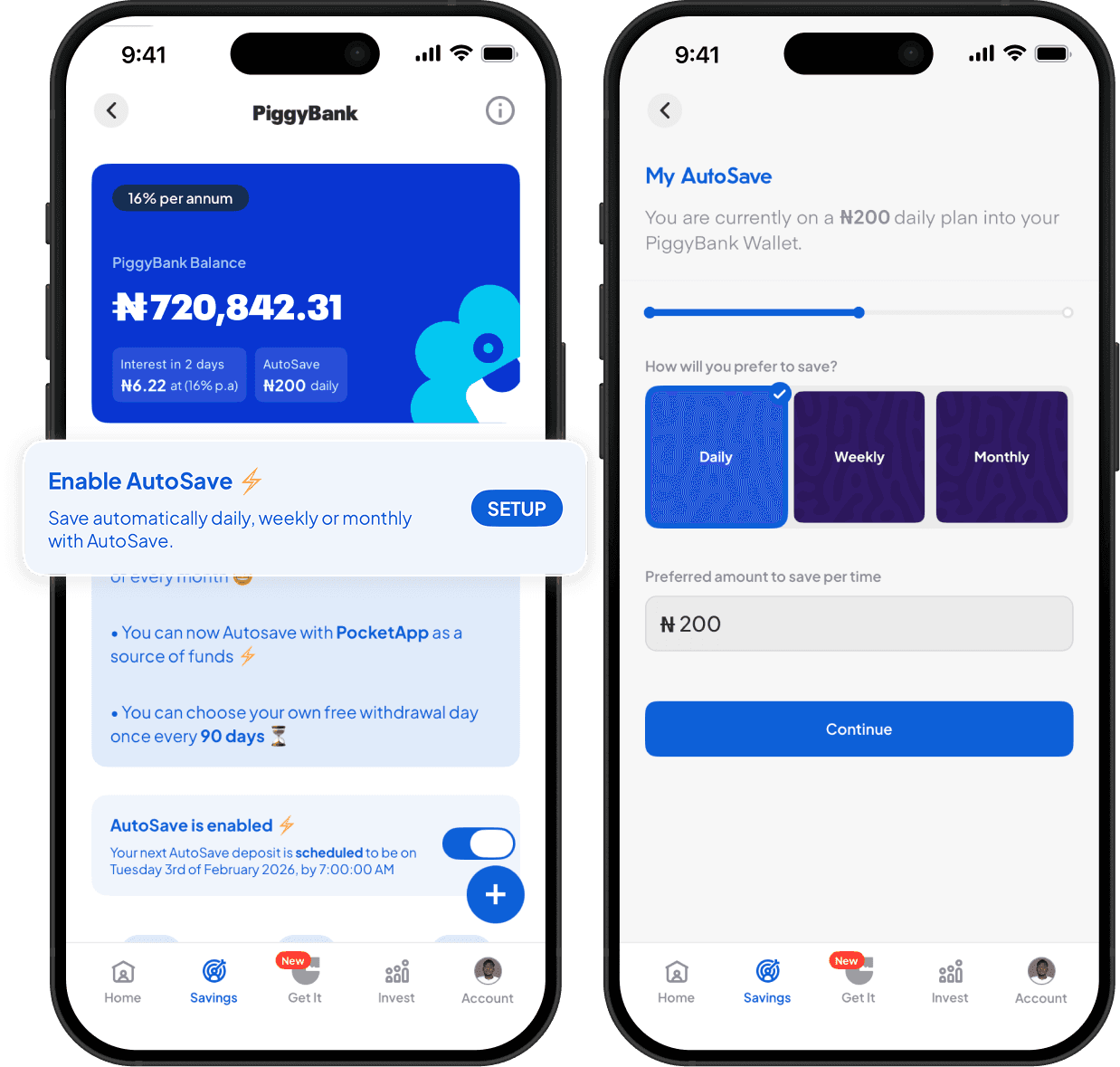
PiggyVest says you can save into Piggybank in two main ways: Autosave and QuickSave. Autosave is the recurring option, with daily, weekly or monthly schedules. Once you set it up, savings run automatically, and PiggyVest says you can pause, resume or modify the amount and frequency later.
The published entry thresholds depend on how often you want to save. Daily Autosave can be set between ₦50 and ₦200,000. Weekly Autosave can be set between ₦800 and ₦1,000,000, while monthly Autosave can be set between ₦3,000 and ₦5,000,000.
That means the lowest clearly stated entry point for Piggybank is ₦50, using daily Autosave. To make that practical, ₦50 a day adds up to ₦18,250 over 365 days if you keep it running. At the weekly minimum of ₦800, you would put away ₦41,600 over 52 weeks. At the monthly minimum of ₦3,000, you would save ₦36,000 over 12 months.
PiggyVest also says you can top up at any time with QuickSave, which is the manual option. The limitation in the supplied material is that no separate minimum QuickSave amount is stated on the reviewed page, so it would be wrong to invent one here. What is confirmed is simply that QuickSave exists for manual top-ups and the clearly sourced minimum entry point overall remains ₦50 via daily Autosave.
How the interest works in plain English
PiggyVest’s current FAQ lists Piggybank at 16% per annum. It also says interest accrues daily on your balance, shows on your dashboard and is paid monthly on the 1st day of a new month. That gives you a clear mechanic: your balance earns interest day by day, but the payout does not wait until year-end.
A simple way to think about the number is with a steady balance example. If you kept ₦500,000 in Piggybank for a full year at a constant 16% per annum, that works out to ₦80,000 in gross annual interest. Spread across 12 months, that is roughly ₦6,667 per month on average before any rate change. If you kept ₦100,000 there for a full year at the same unchanged rate, the annual gross interest would be ₦16,000.
The awkward but important caveat is that PiggyVest also says rates are subject to change based on market conditions. So the 16% figure is the current quoted rate, not a permanent promise you can lock in forever from the supplied material alone. In other words, you should treat the rate as real but variable, not as something guaranteed for the entire life of your savings plan.
Withdrawal rules: this is where the product becomes either useful or annoying
Piggybank withdrawals are free only on approved free withdrawal dates. PiggyVest lists the fixed free dates as 31 March, 30 June, 30 September and 31 December. If you are happy to structure your saving around quarter-end access, that rule is straightforward.
PiggyVest also says new users can create their own free withdrawal day after saving for at least 90 days. But there is a catch that matters: once you choose a custom free date, the next one is 90 days later, and you no longer qualify for the fixed quarterly PiggyVest dates. That is more flexible than being locked only to quarter-end, but it is not extra access; it is a replacement schedule.
If you withdraw outside a free withdrawal date, the current penalty is 3.5%. This is the single most important cost in the whole product. On a ₦100,000 withdrawal, 3.5% is ₦3,500. On ₦500,000, it is ₦17,500. On ₦1,000,000, it is ₦35,000. That is not a small administrative charge; it is a meaningful penalty meant to discourage early access.
There are a few more mechanics worth knowing before you assume access will be easy in an emergency. The minimum Piggybank withdrawal is ₦3,000 and PiggyVest says there is no maximum. But users can only withdraw once in 24 hours, and withdrawals above ₦3 million take up to 3 working hours on weekdays. Withdrawals can go to your linked bank account, your Pocket account or Flex Naira, and transfers from Piggybank to Flex Naira still count as withdrawals.
That last point matters because some savers assume moving money inside the same app might avoid the rule. Based on the supplied FAQ, it does not. If you shift money from Piggybank to Flex Naira, PiggyVest still treats it as a withdrawal for these limits and timing rules.
The real fee picture: not monthly fees, but a real behavioural penalty
PiggyVest’s terms say there are no transaction charges or monthly fees for the service apart from processing fees linked to specific products. For Piggybank itself, the relevant fee rule is simple: withdraw on your free withdrawal date and pay nothing; withdraw outside it and pay 3.5%.
This is worth spelling out because "no fees" can sound more generous than the actual experience. It is true in the narrow sense that Piggybank does not come with a monthly maintenance fee in the supplied material. But if you routinely break your savings before a free date, the 3.5% penalty will matter much more to your outcome than a small monthly charge would have.
There is one more fine-print issue to keep in view. PiggyVest’s legal terms add that it may communicate a different percentage in future. So the current consumer-facing rule is 3.5%, but the terms reserve the right to change that percentage with notice later.
Safety and regulation: what is confirmed and what is not
On safety, PiggyVest’s FAQ says customer funds in a PiggyVest account are warehoused and managed by PV Capital Limited (RC No. 1760152). PiggyVest describes PV Capital as a duly registered Fund/Portfolio Manager with the Securities and Exchange Commission of Nigeria and says its operations comply with applicable regulations. The same FAQ also points to bank-grade security and 2FA as part of its safety setup.
That is the confirmed regulatory framing in the supplied material, and it is worth stating precisely rather than vaguely. The packet supports that PiggyVest says funds are managed through PV Capital and that PV Capital is presented as SEC-registered in that role. The packet does not independently verify a separate licence category for PiggyVest itself beyond that statement, so it is better to stick to what is directly sourced.
Operationally, the eligibility rules also tell you this is not a casual anonymous product. To use PiggyVest, you must accept the terms, register, be a Nigerian citizen or legal Nigerian resident aged at least 18, have a bank account with a Nigerian financial institution and provide identity and bank information. PiggyVest may also request KYC documents such as a government-issued photo ID and a recent utility bill or bank statement.
Company background and a small transparency issue
PiggyVest says it first launched as Piggybank.ng on 7 January 2016 as a savings-only platform and rebranded to PiggyVest in April 2019. The company’s FAQ lists its location as Tesmot House, 3 Abdulrahman Okene Close, off Ligali Ayorinde, Victoria Island, Lagos.
There is one detail in the supplied official material that deserves a plain note. PiggyVest’s About page says the company has "6,000,000 users and counting," while a later keynote post dated 3 April 2026 says "Nine million customers later." Those are both official PiggyVest claims, but they conflict, so the most honest way to present them is as conflicting official numbers rather than picking one and pretending it is settled.
The interest opt-out feature: useful, but not certification
PiggyVest’s FAQ says users who do not want to earn interest can go to Account and toggle off "Interest Enable on Savings (Riba)." That is a practical feature for users who do not want interest credited on savings.
But it is important not to overstate what that means. The supplied material does not present Piggybank as Sharia-certified, and it does not name a certifying board or authority. So this is best understood as an interest opt-out feature, not proof of halal or Sharia-compliant status.
Pros & cons
Pros
- +Autosave can be set on daily, weekly or monthly schedules.
- +The lowest clearly sourced entry point is ₦50 through daily Autosave.
- +PiggyVest lists Piggybank at 16% per annum, with daily accrual and monthly payouts.
- +Free withdrawals are available on fixed quarterly dates, and users can create a custom free withdrawal day after at least 90 days of saving.
- +PiggyVest says there are no monthly fees or transaction charges for the service apart from product-linked processing fees.
Cons
- -Withdrawals outside free dates attract a 3.5% penalty, which can be expensive on larger balances.
- -Once you choose a custom free date, you lose access to the fixed quarterly dates and move to a 90-day cycle.
- -You can withdraw only once in 24 hours.
- -Withdrawals above ₦3 million can take up to 3 working hours on weekdays.
- -The published 16% rate is subject to change, so future returns are not fixed from the supplied material.
Who this is for
Piggybank makes the most sense for you if your real problem is consistency and self-control, not lack of access. If you want money to move out of reach automatically, can live with waiting for quarter-end or a planned custom date, and do not want to start with a large amount, the structure is sensible. Someone saving ₦50 daily, ₦800 weekly or ₦3,000 monthly can use it without needing a big opening balance.
It is a weaker fit if your cash flow is unpredictable or you frequently need emergency access to your savings. In that situation, the 3.5% penalty is not a theoretical downside; it can become a recurring cost. It is also not for anyone under 18, or for people without a Nigerian bank account or the ability to complete the required KYC checks.
Fee breakdown
Here is the plain-English cost picture from the supplied terms:
| Item | What PiggyVest says |
|---|---|
| Monthly fee | None stated |
| Transaction charges | None stated for the service, apart from processing fees linked to specific products |
| Withdrawal fee on free withdrawal dates | ₦0 |
| Withdrawal penalty outside free dates | 3.5% currently |
| Minimum withdrawal amount | ₦3,000 |
| Maximum withdrawal amount | No maximum stated |
A few worked examples make the penalty easier to feel:
- Withdraw ₦50,000 outside a free date and 3.5% = ₦1,750.
- Withdraw ₦100,000 outside a free date and 3.5% = ₦3,500.
- Withdraw ₦500,000 outside a free date and 3.5% = ₦17,500.
One detail that should not be hidden in fine print: PiggyVest’s terms say it may communicate a different penalty percentage in future. So 3.5% is the current rule, not an unchangeable cap forever.
Spotlight: The custom free withdrawal day
The most unusual mechanic surfaced in the supplied research is Piggybank’s option to replace the standard quarter-end withdrawal schedule with your own free withdrawal day. PiggyVest says new users can create this only after saving for at least 90 days.
Why this matters is that it gives you some control over timing without turning Piggybank into a flexible wallet. For example, if the built-in dates of 31 March, 30 June, 30 September and 31 December do not match your cash needs, you can set a date that suits you better. But the tradeoff is strict: once you choose that custom date, your next free date comes 90 days later, and you stop qualifying for the fixed PiggyVest quarterly dates.
So this feature is helpful only if you use it deliberately. It is not extra withdrawal freedom layered on top of the normal schedule. It is a different schedule with the same underlying discipline.
Competitor mention
If you are comparing within PiggyVest itself, Flex Naira is the easier-access option because PiggyVest says you can withdraw or transfer anytime for free, though more than 4 bank withdrawals in a month or more than 6 Pocket withdrawals causes you to lose that month’s accrued Flex interest. Target Savings is goal-based, but breaking it before maturity sends funds to Flex and costs you the accrued interest plus a 1% processing fee.
Regulatory note
PiggyVest says customer funds are warehoused and managed by PV Capital Limited (RC No. 1760152), which it describes as a duly registered Fund/Portfolio Manager with the Securities and Exchange Commission of Nigeria. That is the regulatory status claimed in the supplied material. The packet does not independently verify a separate licence category for PiggyVest beyond that statement, so this review is relying on PiggyVest’s own published disclosure.
Bottom line
PiggyVest Piggybank is a good fit for you if you want a savings tool that makes it harder to sabotage your own plan. The combination of low entry points, automated saving, a quoted 16% per annum rate, and free withdrawals on scheduled dates gives it a clear use case: disciplined saving for money you do not need every week.
You should look elsewhere if access is your top priority. The 3.5% early-withdrawal penalty is real, the free-withdrawal windows are limited, and even the attractive quoted rate is still subject to change. In plain terms: Piggybank works best for planned savings, not for emergency cash management.
FAQ
Frequently Asked Questions
What is the minimum amount to start PiggyVest Piggybank?
When can I withdraw from Piggybank for free?
What happens if I withdraw before my free date?
Is PiggyVest Piggybank safe?
Can I turn off the interest on Piggybank?
If Piggybank sounds close to what you need, the next smart step is to decide one thing before opening it: are you saving for discipline or for quick access? If it is discipline, the rules may help you. If it is quick access, read PiggyVest’s Flex Naira and Target Savings rules first so you do not choose a stricter product than your cash flow can handle.
Sources
- “We owe you the next ten years” | Keynote Speech by Odunayo Eweniyi at Piggyvest at 10 Gala - Piggyvest Blog(official_site)
- About Piggyvest(official_site)
- Terms - PiggyVest(official_site)
- FAQs - PiggyVest(official_site)
- FAQs - PiggyVest(official_site)
- Terms of Use - PiggyVest(official_site)